
Delaware Legislators Consider Johnson Amendment Backstop
An effort to prevent Civil Society from dying with its rights on.

Despite high profile defections, like Elon Musk’s Tesla and SpaceX, Delaware remains the preferred state for profit-seeking corporations. Opinions vary, but a lot of people think Delaware is also the preferred place for nonprofit corporations. After all, the wealthiest nonprofit in the history of the world incorporated in Delaware. Still, I wouldn’t be so sure the same considerations applicable to for-profits also apply to nonprofits. The famed laissez faire governance flexibility, predictability, and business friendly judiciary in Delaware law is undercut to some extent by governance and fiduciary responsibilities imposed on nonprofits by federal tax law, under IRC 501 and 4958.
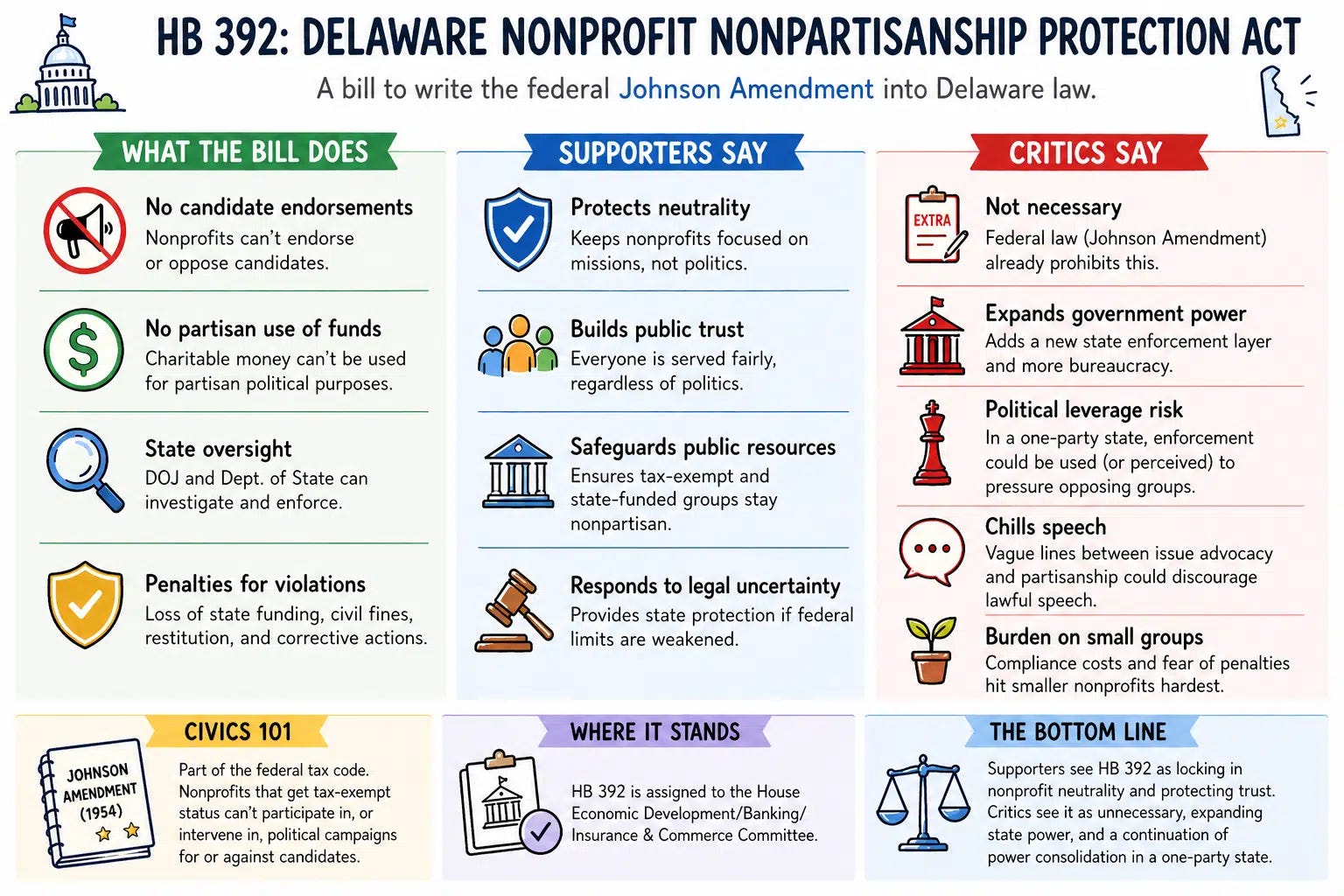
I don’t have a firm opinion. The question just crossed my mind as I considered a proposed bill in Delaware that would maintain the Johnson Amendment even if it were repealed or weakened at the federal level. The Nonprofit Nonpartisanship Protection Act is consistent, though, with Delaware’s historic concern with protecting business from extraneous adventures detracting from the primary purpose of making money. Delaware recognizes public benefit corporations, for example, but it adopted its own statute rather than adopting the Model Benefit Corporation Act. Delaware wanted to insure investor primacy over public benefit.
Similarly, the NNPA doesn’t seem motivated by partisans on one side or the other. It seems motivated, instead, by the desire to ensure nonprofits stick to their missions and stay out of politics on any side. Delaware likes to keep its sectors in their own lanes. Neat and tidy, you see. So the act appears motivated not by conservative or progressive nonprofit hegemony, but by a desire to preserve an important sector of its entity environment. Here are the whereas clauses:
WHEREAS, nonprofit organizations play a vital role in strengthening Delaware’s communities by providing essential services, advocating for public interests, and fostering civic engagement; and
WHEREAS, the Johnson Amendment, codified in Section 501(c)(3) of the Internal Revenue Code, has ensured that charitable organizations, religious institutions, and foundations remain nonpartisan and free from political influence in exchange for tax-exempt status; and
WHEREAS, preserving the nonpartisan nature of nonprofit organizations is critical to maintaining public trust, ensuring that charitable resources are not diverted for political purposes, and preventing undue influence from partisan interests; and
WHEREAS, the federal government has considered proposals to weaken or repeal the Johnson Amendment, potentially allowing tax-exempt nonprofits to engage in partisan political activities, which could undermine their integrity and mission.
I guess I am somewhat of a free speech zealot. I mean, I pretty much say whatever I want on this Stack. And I have often argued that that the Johnson Amendment is just plain unconstitutional, especially but not just when applied to houses of worship. The part of the bill that prohibits Delaware nonprofits from using “charitable funds, grants, or donations for a partisan political purpose” is probably too vague to enforce, by the way.
But there is such a thing as “dying with their rights on.” Nonprofits that insist on their acknowledged right to participate in partisan politics (we know it when we see it), could very well be signing on to the destruction of their own sector. At least with the Johnson Amendment, nonprofits can assert that they are “not in it for politics.” But once people come to think of nonprofits as political operators just like everybody else, Civil Society writ large will have forfeited much of its credibility and moral high ground.